
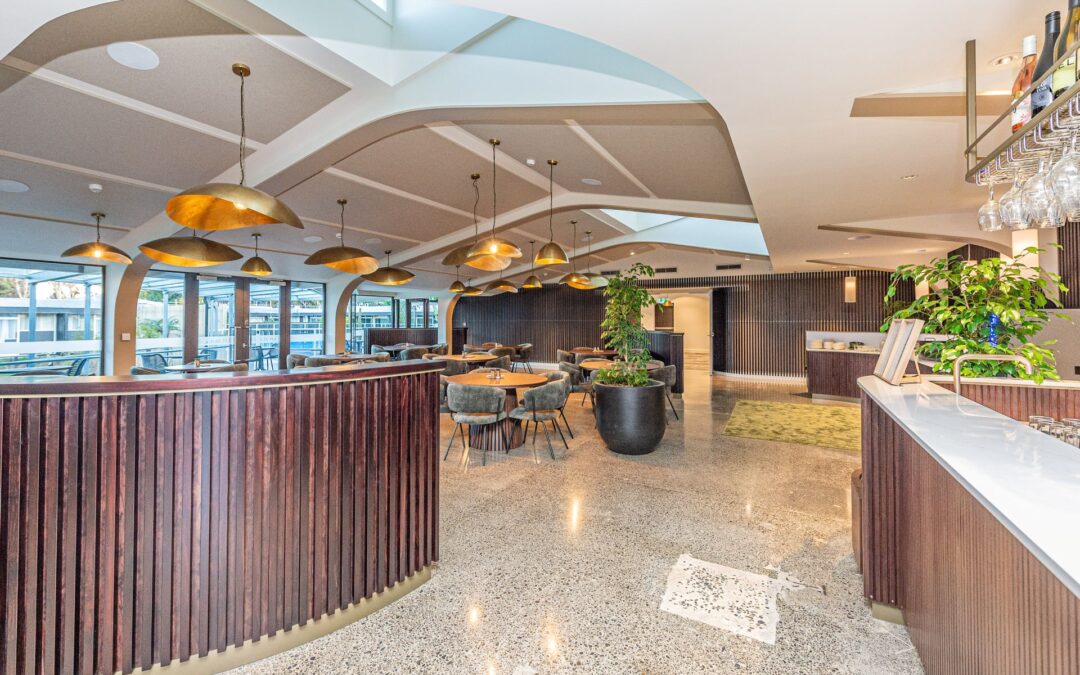
The Black Pine team is delighted to have contributed to two articles in the River City Press as part of a feature celebrating the opening of the Glasshouse restaurant, bar and conference facilities at The Avenue Hotel in Whanganui.
This has been a massive project in every sense, so we’re grateful for the opportunity to share some of the design thinking that went into the rebuild.
To view the full feature, visit the River City Press print archive (July 9, 2026 edition, pg 12). The below transcripts have been republished with permission.
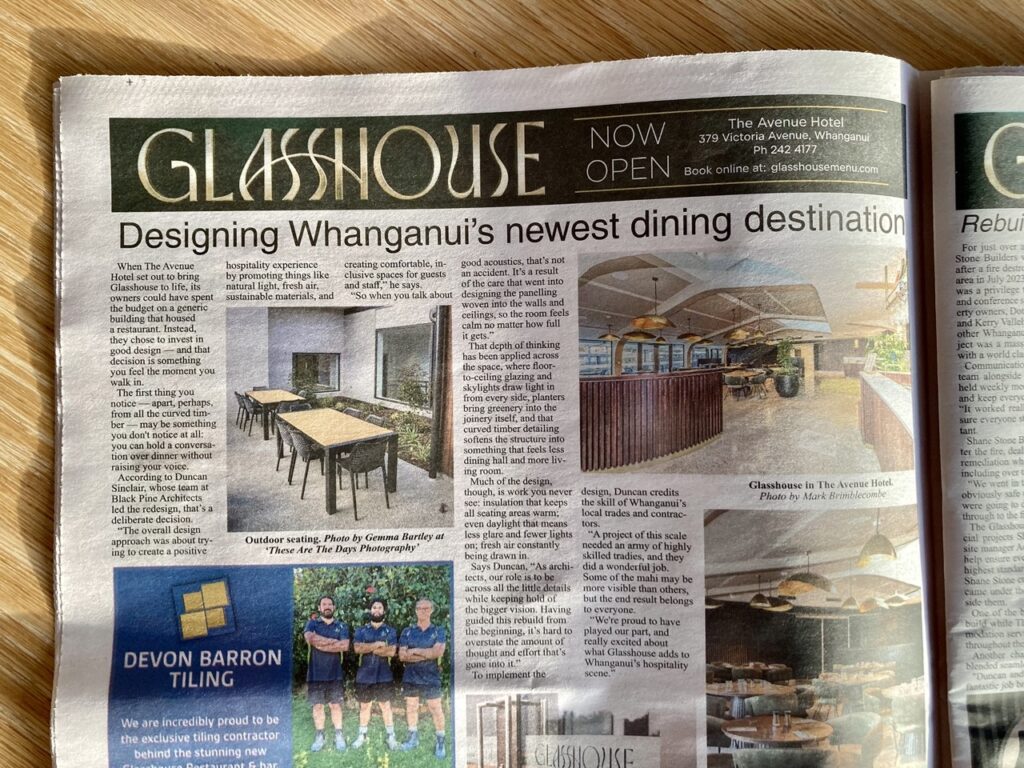
Designing Whanganui’s Newest Dining Destination
When The Avenue Hotel set out to bring Glasshouse to life, its owners could have spent the budget on a generic building that housed a restaurant. Instead, they chose to invest in good design — and that decision is something you feel the moment you walk in.
The first thing you notice — apart, perhaps, from all the curved timber — may be something you don’t notice at all: you can hold a conversation over dinner without raising your voice.
According to Duncan Sinclair, whose team at Black Pine Architects led the redesign, that’s a deliberate decision.
“The overall design approach was about trying to create a positive hospitality experience by promoting things like natural light, fresh air, sustainable materials, and creating comfortable, inclusive spaces for guests and staff,” he says.
“So when you talk about good acoustics, that’s not an accident. It’s a result of the care that went into designing the panelling woven into the walls and ceilings, so the room feels calm no matter how full it gets.”
That depth of thinking has been applied across the space, where floor-to-ceiling glazing and skylights draw light in from every side, planters bring greenery into the joinery itself, and that curved timber detailing softens the structure into something that feels less dining hall and more living room.
Much of the design, though, is work you never see: insulation that keeps all seating areas warm; even daylight that means less glare and fewer lights on; fresh air constantly being drawn in.
Says Duncan, “As architects, our role is to be across all the little details while keeping hold of the bigger vision. Having guided this rebuild from the beginning, it’s hard to overstate the amount of thought and effort that’s gone into it.”
To implement the design, Duncan credits the skill of Whanganui’s local trades and contractors.
“A project of this scale needed an army of highly skilled tradies, and they did a wonderful job. Some of the mahi may be more visible than others, but the end result belongs to everyone.
“We’re proud to have played our part, and really excited about what Glasshouse adds to Whanganui’s hospitality scene.”
Good Design Leaves a Lasting Legacy
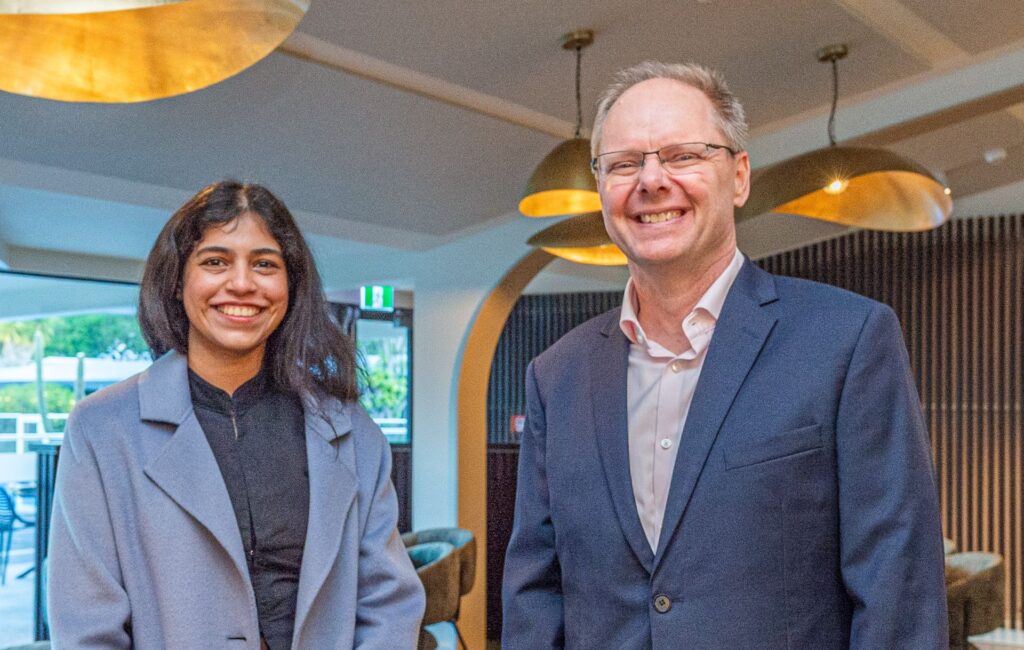
Reshma Cherian and Duncan Sinclair of Black Pine Architects
When people talk about good design, the conversation often focuses on appearance. But the true value of design runs deeper than aesthetics.
Good design creates places people want to spend time in. It supports businesses, strengthens communities, improves wellbeing, and ultimately creates more valuable assets.
According to Duncan Sinclair of Black Pine Architects, that’s why smart leaders see investing in design as an intelligent business decision.
“The most successful projects are the ones that think carefully about how a building will perform, how people will experience it, and how it will age over the next 20, 50, or 100 years,” he says.
For decades, sustainable and environmentally conscious design was often viewed as being at odds with commercial outcomes. Today, that thinking has moved on.
Frameworks like the Living Building Challenge encourage designers to consider not only how buildings minimise their environmental impact, but how they contribute positively to the health of people and ecosystems. Duncan believes these principles enhance the potential for commercial success.
“There’s a misconception that sustainability or healthy-building principles come at the expense of commercial returns,” he says. “In reality, they’re closely linked. Buildings that are nicer to be in, more efficient to operate, and more connected to their environment are more desirable places to live, work, visit, and invest in.”
The same thinking sits behind biophilic design, which recognises the benefits of connecting people with nature through light, planting, fresh air and natural materials. An example of these regenerative principles can be seen in the gardens at the Glasshouse precinct; while newly established, they will mature into an important green space within a busy part of the city.
For Black Pine, that long-term view is captured in the practice’s commitment to being “good ancestors” and kaitiaki.
“We try to think beyond immediate outcomes,” says Duncan. “The question isn’t just whether a project works on opening day. It’s whether it will still be adding value to the community decades from now.”
With Whanganui being New Zealand’s only UNESCO City of Design, and in a year that will see it host the inaugural Festival of Design, that mindset feels especially relevant. As Duncan sees it, investing in thoughtful design is ultimately an investment in Whanganui itself.
“Good design creates places people remember. It creates stronger businesses, more resilient communities, and buildings that hold their value over time. That’s why design matters.”